Showing posts with label wind energy. Show all posts

Tuesday, July 13, 2010

Spinning Molly


“It doesn’t matter how many pictures you look at or even how many video clips you watch,” Molly says, “nothing comes close to the first-hand experience of seeing those little rugrats stampeding the bus, chanting “wazungus” in complete unison as we rolled into school the first day.”

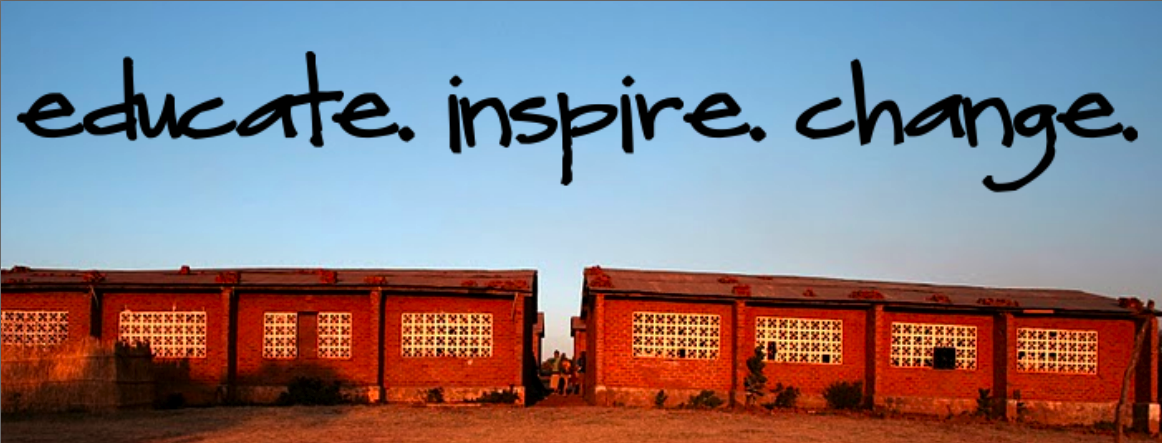
A swirl of noise and wind surrounded our circle of kids during the morning songs on the first day of camp. The first school we visited for the second summer session of World Camp was a primary school composed of 5 brick buildings and a few hundred kids in the village of Mitundu. We screamed out songs over roaring bulldozers paving a new road next to the school and a sea of surrounding rugrats (our affectionate name for the kids who play around the school, but aren’t old enough to attend). Somehow, Molly, Brittanny and I managed to get all of the school kids spinning and cheering about bananas in the middle of the circle.

Molly, a tall, energetic brunette who likes to refer to herself as the token Jew on the volunteer staff, recently graduated from the University of Michigan at Ann Arbor and decided to volunteer before finding a permanent job. “I had been looking at a variety of different programs all around the world. I would look at them, bookmark them, and then never apply. When I found World Camp I had applied and was talking to Jesse (the program director) within 20 minutes,” she says.

Although our four day program at Mitundu went by in a whirl, Molly bonded with her students and is already teary eyed about having to leave them. “I think that it took two solid days before I knew my students on a personal level,” she says. “I guess on the first day I never foresaw the relationships that I had made with the students just two days later.”
The four day camp session includes sections on HIV/AIDS education, environmental education and gender equality. Each day is broken up into different sections of each, emphasizing hands on activities and group work. On the first day, the kids pretended to be T-cells and had to defend their classroom for a cold at the door, only to be killed off by the HIV virus.

To get the kids thinking about alternative sources of energy, we did an exercise on wind energy where they got to make their own pinwheel. “We took the kids outside to try their pinwheels. At first, they were working but the pins would come out,” Molly says. The kids kept running back to her and her teaching partner, Paige, and their Chichewa field staff, Segas. “Then they got a glimpse of these two boys on a dune by our classroom. All you could see were their pinwheels really spinning. It was quintessential pinwheel spinning; it could’ve been a commercial for pinwheels,” she laughed. “Once the class caught glimpse of that we all raced out to dunes and just stood on top of the dune to watch our pinwheels spin.”

Although she’ll miss her class at Mitundu, she did exchange numbers with them. “If I’m ever back, we’ll have some nsima together,” Molly says.


post submitted by B. Mole

Friday, June 25, 2010

William Kamkwamba

Summer Session 1 volunteers spent their final full day in Malawi with William Kamkwamba, The Boy Who Harnessed the Wind. At age 14, William was forced to drop out of secondary school because his parents could no longer afford his school fees. Determined to keep up with his studies, William spent his free time in the library. After reading books on electricity, William built one windmill that generated electricity so he could study at night and another to irrigate his family's fields. A few weeks ago William graduated from secondary school in South Africa and is planning on attending Dartmouth this fall.

William was back in his home village, Wimbe in Kasungu District, for a ceremony at his primary school to hand over the keys to a brand new solar powered building. Volunteers arrived before the ceremony and got a firsthand tour of the school from William, as well as a detailed description of his plans to power the entire school with a single windmill. William was incredibly open to answering questions, telling stories, and taking pictures! Once the ceremony started, two of William's childhood friends, Gilbert and Geoffrey, took us to William's home where we met William's mother and siblings and got a demonstration of exactly how the windmills operate.


The second and third windmills William constructed generate power for his house and irrigate the family's crops.


Geoffrey showing how the windmill pulls a rope up and down to pump water out of the borehole.


The WC group with William's mom and best friends Gilbert and Geoffrey.

Thursday, May 27, 2010

Wind Energy Pictures!!!

First run of our new wind energy curriculum on Wednesday was a huge success!!  

Photo 1: volunteer teachers Keyoor and Sara Jane and field assistant, Patience, facilitate a discussion about natural resources that are non-renewable vs. renewable. 

Photo 2: A student in Sarah, Elizabeth, and Chris' class had seen a wind turbine at an orphanage about 20 km from this village. He was able to draw a 3D picture on the board and promised to take the rest of his class to see it.

Photo 3, 4, & 5: students were pumped about their individual pinwheels and ran outside to test them in the wind. Community members trickled in to check it out.


Photo 6: Even the teachers, led by Kristin, Amanda, and Doreen, built a model wind turbine to show how we can use the power of the wind to "do work," by pulling up a pen.

Tuesday, May 25, 2010

Exploring Alternative Energies in Malawi

One of the exciting aspects of our new 4 Day curriculum is the expansion of our environmental section. We began with our current solar energy activity-testing one mock solar oven painted black and one with a black bottom and foil sides. Early volunteer arrivers, Elizabeth Smith and Blair Lindley, assisted Coordinators with this endeavor. No surprise there, but the second oven got about 10 degrees hotter! Indeed, black to absorb the sun and foil to reflect the heat back in does work.
Coordinators Karen Clark and Katy Lackey have also been researching ways and partnering with a few organizations to actually bring real solar ovens to the communities we work in. More on these opportunities to come. 
Partly inspired by a desire to bring a more practical alternative energy source to our schools' villages (cardboard solar ovens have a little trouble heating nsima), partly by questions raised in Teacher Workshop meetings, and partly by William's story in The Boy Who Harnessed the Wind, this summer we'll be piloting World Camp's first ever wind energy section!!

Each camp participant will make their own pinwheel, while each class will build a model wind turbine that demonstrates how wind can convert energy to "do work," as evidenced by the model pulling up a pen. Karen Clark built our first ever model (a success!), while Blair Lindley taught our Summer Session 1 group our to deliver the material to our kids during orientation.  

A huge shout out and thanks to former volunteers Gretchen Visser, David Ederer, Caitlyn Cunningham, Maggie Savage, Monica Ralston, and Coordinator Rachel Dudasik for their help in developing this section!!

Stay tuned and we'll let you know how it goes!


Monday, March 15, 2010

Malawi youth wins GIA award, fights climate change and poverty

You may recognize him from an episode of the Daily Show in October. You may have read about him from a book that hit the stands this Christmas. Or you may have heard his name mentioned by someone you know who's volunteered with us. Needless to say, we at World Camp couldn't be more thrilled to read in today's newspaper that the young and remarkable Malawian, William Kamkwamba, is a recipient of the GIA or the "GO Ingenuity Award" in Ghana! Read the full article.

The award recognizes the impacts of inventors and artists in developing countries. William's achievements and recent fame center on his construction of a windmill from scrap materials gathered near his village. But what's striking about his story doesn't end there.

William grew up in a small village, Wimbe, in Kasungu District (north of Lilongwe). His family, like so many others, was hit hard by the 2003 drought and famine, and could no longer afford to send him to school. Even if he had been in school, when it gets dark in an African village, it gets dark. The kind of dark where you keep waiting for your eyes to adjust, but it never happens. What this means for so many youth here is that once night falls, that's it-no way to complete homework or read. Can you imagine if you couldn't do anything after dark? It's 6:30pm here in Lilongwe and dark.
So William spent his time pouring through books in a community library. The kid seemed to have a nack with figuring out how things work, but still! He had never even taken a physics class, but learned about wind energy and constructed a windmill in a village with practically nothing. And it worked!! I mean, I have 2 college degrees, and I didn't even fully understand the chapters on how he did it.

Only 2% of the country is hooked up to the electrical grid, thus having electricity. Only 2%!! Those of you who have been here probably remember the frequent power outages. Did you know that these are actually often a result of deforestatio? Dust, branches, trash, mud is pushed into the country's main electrical plant in Blantyre during storms, due to the soil erosion and lack of trees surrounding the area.

So you can imagine what a windmill in a Malawian village means. Access to resources that hardly anyone has. Light to read after dark. And a sustainable source of power that does not further contribute to the pressing deforestation and environmental challenges in Malawi.

What I find most inspiring about William is that he is not so extraordinary. Reading his story and hearing his thoughts, I was reminded of so many kids in our empowerment discussions. William and our students share similar histories, grew up in similar places, face similar challenges, and have similar aspirations. And it encourages me that now, when a kid looks at me with that look like no one has ever told her/him that they believe in them, I can share William's story, a story that is real and that they can relate to.

So, a sincere thank you toWilliam. And to the rest of you, come on, the world is changing, and we've got work to do!
**If you haven't read The Boy Who Harnessed the Wind, you must. It pretty much describes Malawi, good and bad, the way I would always like to to my friends and family back home**

Thursday, September 3, 2009

The Boy Who Harnessed The Wind


Check out his post by Ethan Zuckerman of Worldchanging:

I thought I knew William Kamkwamba’s story. I was in the audience at the TED Global conference in Arusha, Tanzania when William took the stage to introduce himself and the remarkable windmill he’d built at his family’s house in rural Malawi. Like dozens of others in the audience, I was moved first to laughter, and then to tears by William’s explanation of how he turned some PVC pipe, a broken bicycle and some long wooden poles into a machine capable of generating sufficient current to power lights and a radio in his parents’ house: “I try, and I made it.”